

Introduction
Understanding frontend vs backend meaning is one of the most important steps for anyone starting a career in web development. If you are new to websites, apps, or coding, you might have heard these terms many times but still feel confused. Simply put, frontend vs backend meaning explains how websites are built and how they work behind the scenes.
The frontend is what users see and interact with, while the backend works behind the screen to make everything function smoothly. Together, both parts create a complete web application. Without one, the other cannot properly function.
In today’s digital world, every website, from social media platforms to online stores, depends on frontend and backend systems. That is why learning frontend vs backend meaning is essential for beginners and intermediate learners who want to enter tech or improve their understanding of web development.
This article will explain everything in simple English, with real examples, benefits, mistakes, and expert tips so you can clearly understand how both sides work together.
What is Frontend vs Backend Meaning?
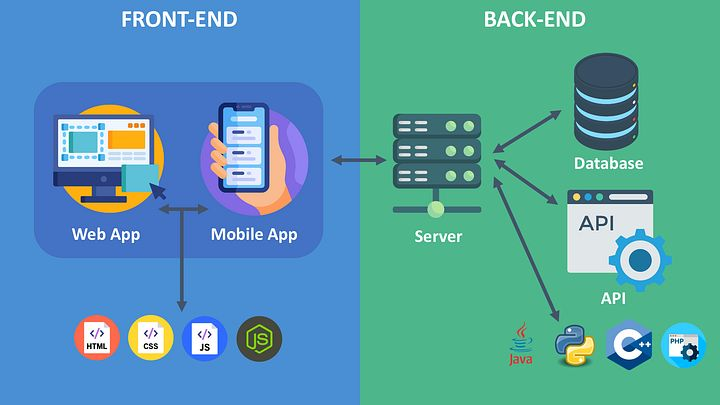
Frontend vs backend meaning refers to the two main parts of web development that work together to build a complete website or application. The frontend is the visual part of a website that users interact with directly. It includes everything you see on the screen such as buttons, images, text, menus, and layouts. It is built using technologies like HTML, CSS, and JavaScript.
On the other hand, the backend is the hidden part of a website that handles data, server logic, and database management. It ensures that everything on the frontend works properly. For example, when you log into a website, the backend checks your username and password and gives you access.
So, frontend vs backend meaning is basically about user interface versus server-side logic. The frontend focuses on design and user experience, while the backend focuses on functionality and data processing.
Without understanding frontend vs backend meaning, it becomes difficult to build modern websites because both parts are essential and depend on each other.
Why is Frontend vs Backend Meaning Important?
Learning frontend vs backend meaning is important because it helps you understand how modern websites actually work. Most people only see the design of a website, but behind every click, there is a complex system running in the background.
Firstly, it helps beginners choose a career path. If you like design and creativity, frontend development may suit you. If you enjoy logic and problem-solving, backend development might be better.
Secondly, understanding frontend vs backend meaning improves communication between developers. When teams work on large projects, frontend and backend developers must coordinate effectively.
Thirdly, it helps in building better websites. When both parts are understood, developers can create faster, more secure, and user-friendly applications.
Finally, knowing frontend vs backend meaning is useful for freelancing, interviews, and real-world projects. It gives you a strong foundation in web development and makes learning advanced topics easier.
Detailed Step-by-Step Guide
Understanding Frontend Development
Frontend development is the process of creating the part of a website that users interact with directly. It includes layout, design, and interactivity. When discussing frontend vs backend meaning, the frontend is always the visible side.
Frontend developers use languages like HTML for structure, CSS for styling, and JavaScript for functionality. For example, when you click a button and see an animation or a menu drop-down, that is frontend work.
The main goal of frontend development is to make websites attractive, responsive, and easy to use on different devices like mobiles, tablets, and desktops.
Understanding Backend Development
Backend development is the hidden part of frontend vs backend meaning. It deals with server-side operations, databases, and application logic.
Backend developers use languages like Python, PHP, Java, and Node.js. They also work with databases like MySQL or MongoDB. For example, when you sign up on a website, the backend stores your data securely in a database.
The backend ensures that the frontend receives correct data and functions properly. Without backend systems, websites would not be able to process user requests or store information.
How Frontend and Backend Work Together
To understand frontend vs backend meaning completely, you must see how both sides connect. When a user interacts with a website, the frontend sends a request to the backend. The backend processes that request and sends back a response.
For example, when you search for something on Google, the frontend shows the search bar, and the backend fetches results from a huge database and displays them on your screen.
This teamwork between frontend and backend is what makes modern websites powerful and interactive.
Benefits of Frontend vs Backend Meaning
Understanding frontend vs backend meaning provides many advantages:
- Helps you choose a clear career path in web development
- Improves your understanding of how websites work
- Makes learning programming easier and structured
- Increases job opportunities in tech industry
- Helps in building real-world projects and applications
- Improves problem-solving and logical thinking skills
- Useful for freelancing and remote work opportunities
- Enhances communication between developers in teams
Disadvantages / Risks
While learning frontend vs backend meaning is useful, there are some challenges:
- Learning both frontend and backend can take time
- Requires continuous practice and updating skills
- Backend development can be complex for beginners
- Frontend requires knowledge of design principles
- Debugging errors in full-stack projects can be difficult
- Tools and technologies change frequently in web development
- Beginners may feel overwhelmed by multiple programming languages
Common Mistakes to Avoid
When learning frontend vs backend meaning, beginners often make mistakes that slow their progress:
One common mistake is focusing only on design and ignoring backend logic. Another mistake is trying to learn too many programming languages at once, which creates confusion.
Some learners do not practice enough real projects, which limits their understanding. Others skip basic concepts and jump directly into advanced frameworks, which leads to gaps in knowledge.
It is also a mistake to think frontend and backend are completely separate. In reality, they are deeply connected and must be learned together for better understanding.
Avoiding these mistakes will make your learning journey smoother and more effective.
FAQs
1. What is frontend vs backend meaning in simple words?
Frontend vs backend meaning explains the difference between what users see on a website and what happens behind the scenes to make it work.
2. Is frontend easier than backend?
Frontend is often considered easier for beginners because it focuses on visuals, while backend involves more logic and data handling.
3. Can I learn both frontend and backend together?
Yes, you can learn both together and become a full-stack developer, but it requires more time and practice.
4. Which languages are used in frontend?
Frontend mainly uses HTML, CSS, and JavaScript to create user interfaces and design layouts.
5. Which languages are used in backend?
Backend uses languages like Python, Java, PHP, Node.js, and also databases like MySQL and MongoDB.
6. Why do we need both frontend and backend?
We need both because frontend handles user interaction, while backend manages data and server operations, making the website fully functional.
Expert Tips & Bonus Points
When learning frontend vs backend meaning, start with basic HTML, CSS, and JavaScript before moving to advanced frameworks. Practice by building small projects like calculators, to-do lists, or simple blogs.
For backend, focus on understanding how databases work and how data is stored and retrieved. Try building simple APIs to connect frontend and backend.
Another important tip is to practice regularly instead of just watching tutorials. Real coding experience helps you understand concepts faster.
Also, learn how frontend and backend communicate using APIs. This is a key skill in modern web development.
Finally, do not rush. Understanding frontend vs backend meaning deeply takes time, but consistent practice will make you confident and skilled.
Conclusion
In conclusion, frontend vs backend meaning is a fundamental concept in web development that every beginner must understand. The frontend is responsible for the visual experience, while the backend handles data and functionality. Together, they create complete and interactive websites.
Learning frontend vs backend meaning helps you build a strong foundation for a career in technology. It also improves your problem-solving skills and gives you a clear direction in the world of programming.
Whether you choose frontend, backend, or both as a full-stack developer, understanding how these two parts work together is essential. Modern websites and applications depend on this powerful combination.
With practice, patience, and the right learning approach, anyone can master frontend vs backend meaning and start building professional-level projects.
